
Distinctions Between Terminal, Command Line, Shell, and Prompt
By Vladimir Mikhalev · Docker Captain · CNCF Ambassador · IBM Champion
New to Linux and tripping over all the overlapping terms? You’re not alone. People throw around terminal, shell, command line, and prompt as if they mean the same thing. They don’t. And if you’re going to live in the CLI, you should know what each one actually does.
So here’s the distinction, once and for all. Clear, quick, no fluff.
Terminal: The Box That Lets You Talk to the Machine
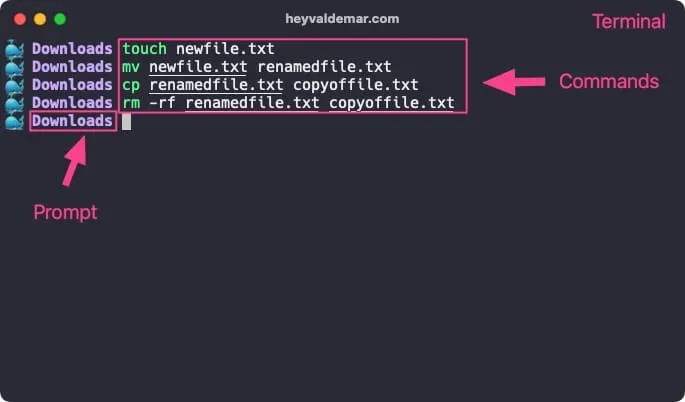
The terminal is just a window. It’s a UI that lets you type into a shell. By itself it executes nothing. Think of it as a container for your CLI session.
Modern terminals are graphical apps that simulate the old physical terminals (yes, actual hardware) that once connected to mainframes. What you’re running is a terminal emulator. A few examples:
The terminal launches your shell and displays its output. That’s the whole job.
Shell: The Thing That Actually Runs Your Commands
The shell is the real workhorse. It’s a program that parses what you type, runs it, and hands back output. It also does scripting, variables, functions, and other niceties. That’s why it’s two things at once: an interactive tool, and a scripting language.
Common Linux shells include:
- bash - the default on many distros
- zsh - feature-rich, used in macOS
- fish - user-friendly, no need to memorize syntax
- sh - minimal, legacy-compatible
Open your terminal and it starts a shell session. Type ls, and the shell interprets it, runs the ls binary, then sends the output back to the terminal. Three steps, one keystroke away.
Prompt: The “Ready for Your Input” Signal
That blinking text sitting there before you type anything? That’s the prompt.
It tells you the shell is waiting. Prompts often carry useful info:
valdemar@devbox:~/projects $valdemar= usernamedevbox= hostname~/projects= current directory$= non-root user (use#if root)
Every shell lets you customize the prompt. Some people pack in Git status, battery life, even the weather. Don’t.
On ancient systems your prompt might be nothing but a lonely % or >. Don’t judge.
Command Line: The Concept, Not the App
The command line isn’t an app. It isn’t a binary either. It’s a concept: an interface for typing commands instead of clicking buttons.
You’ll find a command line in plenty of places:
- A terminal (Linux, macOS, WSL, etc.)
- A dedicated console (like the Windows Command Prompt)
- Your programming language REPL (Python, Ruby, etc.)
You type text commands, you get text output. That’s the command line.
Putting It All Together
Here’s what actually happens when you “open the terminal” on Linux:
- You launch a terminal emulator
- It starts a shell
- The shell shows a prompt
- You enter a command on the command line
- The shell runs the command and shows the result
TL;DR Cheat Sheet
| Term | What It Is | Example |
|---|---|---|
| Terminal | The window or emulator app | GNOME Terminal, iTerm2, Konsole |
| Shell | The program that runs your commands | bash, zsh, fish, sh |
| Prompt | The text telling you the shell is ready | valdemar@devbox:~$ |
| Command Line | The interface where you type commands | ls -al, git status |
Final Thoughts
Knowing the difference isn’t academic trivia. It helps you troubleshoot. Terminal won’t launch? That’s one problem. Shell crashes? Different problem. Prompt looks broken? Your config is probably janky. Nothing responds at all? Maybe you just need coffee.
You’ve got the basics now. So go write a shell script, alias ll to ls -alh, and quit calling everything “the terminal thing.”
You’re one step closer to speaking Linux like a native.